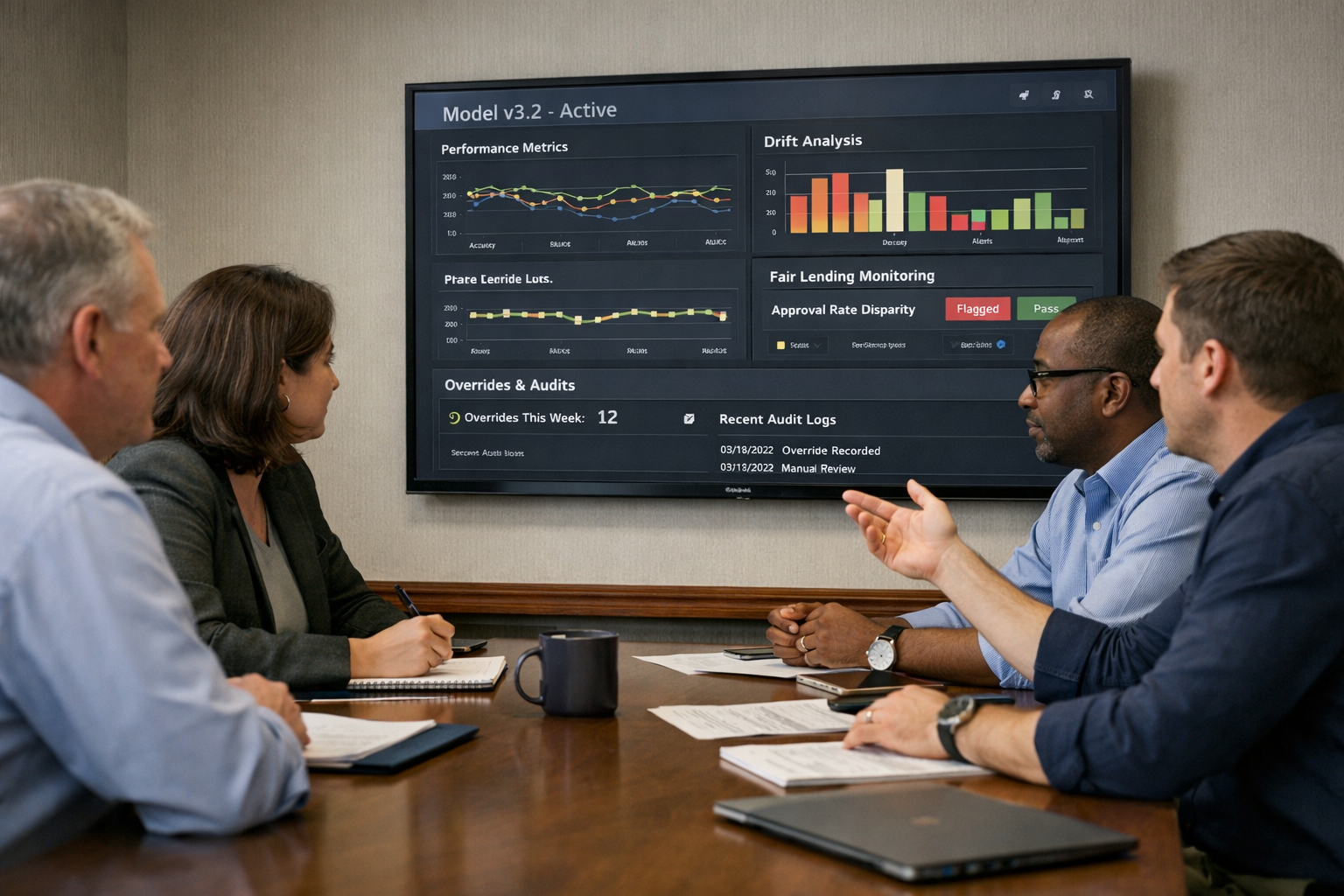
Continuous compliance monitoring is not a dashboard project. It is an operating discipline for detecting meaningful departures from policy or expected control performance, determining who must act, documenting the outcome, and improving the control when the same signal repeats.
Begin with a control question, not available data
Each monitoring routine should answer a defined question: Are required disclosures delivered on time? Are policy exceptions approved by the correct authority? Are complaints concentrated in a product, channel, or population? Are high-risk customers reviewed when required? Starting with the question keeps the program focused on decisions rather than volumes of unprioritized alerts.
The monitoring design record
Identify the requirement, risk, control, products, systems, population, accountable owner, and the outcome the routine is intended to protect.
Document authoritative sources, fields, joins, exclusions, timing, transformations, reconciliation, quality tests, and the versioned query or rule.
Define materiality, severity, segmentation, false-positive treatment, review steps, evidence expectations, escalation, and decision rights.
Set independent review, performance measures, recalibration triggers, issue linkage, approvals, version history, and retirement criteria.
Design for investigation and closure
A useful alert includes the affected record, triggering logic, source values, relevant policy or threshold, comparable history, and the owner who can resolve it. Closure should capture whether the signal was confirmed, the rationale, corrective action, customer remediation if applicable, and any change needed in the process or monitoring logic.
Segment before setting thresholds
A single enterprise threshold can hide risk in smaller portfolios and over-alert in larger ones. Evaluate product, channel, customer, geography, decision path, vendor, and risk tier where those distinctions change the meaning of the signal. Document why segments and thresholds are appropriate and when they must be revisited.
Connect monitoring to issue management
Repeated or material exceptions should not disappear when individual alerts close. Define when a pattern becomes a formal issue, who owns root-cause analysis, what interim treatment is required, how remediation is validated, and how management reporting distinguishes isolated events from systemic weakness.
Measures that reveal program health
Track population coverage, data freshness, reconciliation failures, alert volumes, confirmation rates, aging by severity, repeat events, overdue actions, customer impact, threshold changes, monitoring downtime, and issues identified before independent testing. Interpret these measures together; a falling alert count may reflect improvement, an overly broad exclusion, or a failed data feed.
A practical implementation sequence
- Prioritize control questions using regulatory exposure, customer harm, change velocity, prior findings, and data readiness.
- Build and approve the monitoring design record before automating the routine.
- Run a parallel pilot, reconcile the population, investigate results, and tune thresholds with documented rationale.
- Operationalize ownership, service levels, escalation, quality review, issue linkage, and evidence retention.
- Review performance on a fixed cadence and after material process, product, policy, model, vendor, or data changes.